
Welcoming Christian to the blogosphere

How do I hate the word blogosphere? Let me count the ways...

That aside, my good friend Christian Liensberger, aka Littleguru on Channel9, has just kicked of his own blog with a post demonstrating some of the features of C# 3.0, such as lambda expressions and extension methods.

Christian is one of the smarter people I know, so I'm sure it'll be worth keeping track of his blog. :)

Meiji Jingu Spring Festival and Asakusa

Today I've been in Japan for a month. It certainly doesn't feel that long!

This week as Golden Week, which is mostly a holiday week (only Tuesday and Wednesday were not) so most things like my Japanese lessons were suspended.

By chance, Danny saw that there was a festival at the Meiji Jingu shrine (the same one we visited earlier), so on Thursday, we went there. There was some traditional dance and music, which was really great. Such precise and controlled movements! Besides the pictures, I also made a short video of two of the events.

Afterwards, we went to Asakusa to visit the famous Senso temple.

  • Meiji shrine
  • Some ceremony at Meiji Shrine
  • Some ceremony at Meiji shrine (2)
  • Another wedding
  • Banu and a little girl in traditional dress

30 more images...

Justice at last!

Pretty much from the moment I arrived in Japan I had to listen to friends and family on MSN and Skype saying what beautiful weather it was in the Netherlands, while at the same time it's been fairly hit and miss over here (a few nice days, a few very rainy ones too).

So to everyone who felt the need to remind me of that, I'd just like to say: nyah, nyah, serves you right. :P

Weather in Tokyo and the Netherlands

Earthquake!

I just had my very first earthquake (not just in Japan; the first earthquake of my entire life). I was at home, in my room, when I noticed the room shake. It was very weak, and lasted only a few seconds. In fact, it was so short that I wasn't sure if I'd imagined it or not.

But according to the Japanese Meteorological Agency, there was an earthquake at 21:01 JST, May 8th 2007. It had a magnitude of 4.4 on the Richter schale, but the epicentre was quite a bit away from here, which explains why I barely noticed it (and hardly anyone else here noticed it at all). The JMA uses a scale called the JMA Seismic Intensity Scale. By that scale, the quake was intensity 3 at the centre. According to their breakdown by location, the intensity in this area (Setagaya-ku) was only 1.

The JMA has information about the most recent quakes here. The information about this quake will be on there for about a week (it appears there has already been a more recent quake so this one is off the front page; you can find this one by clicking on of the buttons at the top and then selecting it from the list; that approach should work for a week, then it's gone).

UPDATE: MSNBC writes about the quake.

Rare jongens, die Japanners - Theft

[The title of this post comes from the phrase "Rare jongens, die Romeinen", which is the Dutch version of Obelix's catch phrase "Ils sont fous ces romains" ("These Romans are crazy")]

Having been in Japan for slightly more than a month, I think it's time to reflect on some of the Japanese habits that struck me as strange. Now I'm aware that this has been done to death by pretty much everyone who's been in Japan for more than five minutes, but that's not going to stop me! I will make several posts on this subject, but I will make no guarantees as to when or how often these posts appear (because if I did, I'd probably not be able to keep to it anyway :P ).

The first thing I want to look at is theft, or actually the lack thereof. The Japanese seem to put an enormous amount of trust in their population, since security tends to minimal. I've heard it said that this is because the idea of stealing is so dishonouring that they wouldn't even consider it. Maybe it's because they make it so easy to do that any self-respecting criminal would be ashamed to do something with so little challenge attached.

For example, back in the Netherlands getting into my apartment building was a fairly involved procedure. You needed to use a keycard at the main door (twice, if it was after 23:00; once for the outer door and once for the inner door). The building had four main entrances, but the keycard only worked on the entrance you were supposed to use. Of course there was camera-surveilance too. Then there's the key for the hall containing your room (which can also be used for the mailbox), and finally the room key.

Here, there's no hall keys. No outer door keys. And while there is a guard at the main entrance, all the fire exits are kept open most of the day and may be used for entry without any kind of supervision. This means that if you feel like raiding one of the public areas, such as one of the kitchens, there's not really anything to stop you from doing it.

Stores are even more amazing. In the Netherlands, there are those electronic security devices attached to items. or in a supermarket the only way to leave is through the cash registers. Here, I've yet to see a store with any kind of anti-theft device. In the nearby Seiyu supermarket, because I use the side exit, I have to cross through the vegetable section, with my already purchased items, so it's not only possible to leave the supermarket without passing the registers, it's required.

My bike has a laughable excuse for a lock which would guarantee theft within minutes if this was used at a Dutch train station. But here it's common; I've yet to see the heavy chains that are common in the Netherlands.

Speaking of train stations... the Japanese use a system similar to the Paris subway: you have to use your ticket to get through gates at the entrance and exit (pretty much the only way, since Japanese trains tend to be so crowded you can't even move (and no, this is not an exaggeration), so it would certainly be impossible for someone to check the tickets on the train). In Paris, it is fairly impossible to pass these gates without a ticket. Here, it'd be fairly trivial (except for the enormous number of people who typically dwell at stations; while you could do it, it'd be hard to do unnoticed :P ).

And then there's the enormously crowded trains and stations. Which really is rediculous; for my Dutch readers, you might've been in a train that was so full the driver refused to leave. These are even more crowded than that. Whenever I'm boarding such a train, there's always the point where everyone is so squeezed together that I think it's not humanly possible to for anyone else to come on board and still close the doors. At that point, usually at least five more people manage to get in. The only consolation is that because I'm relatively tall, at least I can still breath.

But I digress. In most Western countries, such conditions would be a prime ground for pick-pockets. Here, it doesn't happen. You can just put your bag on the luggage rack and forget about it until you get out. There's no need to watch your belongings at all (it is then also not surprising that many Japanese tourists in Western countries get robbed quite easily; they're not used to having to watch out for there stuff).

Yes, I'm sure there are plenty of places in Tokyo where walking around at night is not safe, but overall Japan is living up to its reputation as one of the safest countries in the world. :)

When path finding goes wrong

Path finding is a fairly simple problem with well-known algorithms. When you're doing path-finding for a train route this is even easier: all you have to consider is the price and duration of the different possibilities (as well as convenience factors such as number of transfers if you want a really good result).

The website Hyperdia offers a convenient way to find train routes in Japan. When I was looking for a route from Higashi-kitazawa (the station nearest to my lab at Tokyo University) to Shinjuku, it makes sense that it comes up with this route:
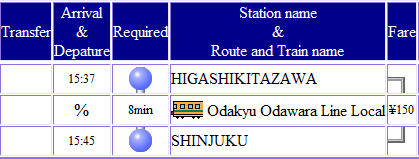
The logical route

Note that I don't actually need Hyperdia to find this out; this route is simple and I've taken it many times (although usually not starting at Higashi-kitazawa but earlier down the line). I was mainly interested in the price from this station, and I wanted to see if it would be faster to walk to Yoyogi-Uehara instead and take an express train. But I digress.

Hyperdia always gives you several alternatives. Sometimes routes that are faster but more expensive, slower but cheaper, take more or less transfers, and, as I've found out today, sometimes it's routes that are slower, take more transfers, and are more expensive! This is the second option Hyperdia lists for this route:
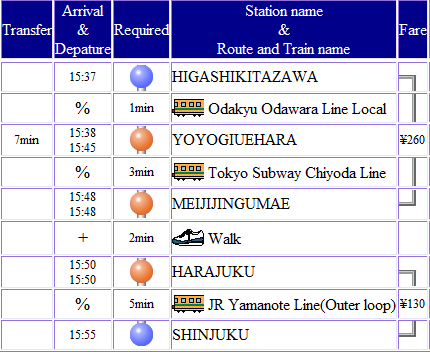
The not-so-logical route

Uhm, ok? I've plotted these two routes on a map. As you can see they appear very similar in terms of distance covered. But the second route takes two transfers instead of zero, is more than twice as expensive, takes almost twice as long, and includes two minutes walking!

Some consolation can be found in the fact that this was at least not the first route it offered, so it does at least recognize that the other one makes more sense. But the fact that this route is offered at all makes you wonder what kind of weird weight-function is used to evaluate these routes? :P

PASMO

Today, I finally got two items I wanted to get for some time. A commuter pass and a PASMO.

I got a student commuter pass from Seijogakuenmae to Shinjuku, for the Odakyu line. This covers one half of the route to the Hongo campus I have to take three times a week, and it also covers the route to my lab (then I get off before Shinjuku, but that doesn't matter, it still works). Plus I can use it whenever I need to go to Shinjuku for something else (and since that's usually the first stop no matter where in Tokyo I want to go, that happens a lot). Despite the fact that most people told me I couldn't get a student pass as long as I was only a research student, I still managed to get one. Which is good, since it's a good deal cheaper than a regular commuter pass. I waited so long to get one because I wanted to at least try to get a student pass, so I had to wait until I had my student ID card.

I considered also getting a pass for the second part (from Shinjuku to Hongo-sanchome with the Oedo line), but I only do that three times per week, and there's far less chance of incidental trips that way than on the way to Shinjuku. The commuter pass would cost almost as much as the single tickets would, so I didn't do it. Plus this affords me the freedom of using alternative routes, such as the Chiyoda line, if I want to.

It should be clear from this little explanation that the biggest problem with Tokyo public transportation is all the different companies. You pretty much have to buy a ticket every time you transfer. So far I've been using a passnet pass, which is a magnetic ticket which you buy in advance. It's not any cheaper than individual tickets, but you buy a fixed amount in advance and can use the pass until it's empty (then you must buy a new one). Passnet works on Odakyu and most subway lines (including the Oedo and Chiyoda lines), so it was fairly convenient. It does not, however, work on the JR lines. JR uses a system called Suica, which is a rechargable IC card (chip card), but that doesn't work for anything besides JR (or at least it used to).

A few months ago they introduced the PASMO. It's a rechargable IC card which works on (afaik) every single train and subway company in Tokyo (even JR; the PASMO and Suica can be used interchangably) and even in most buses. Like Passnet it's not cheaper but it is considerably more convenient. What's more, you can also put a commuter pass onto a PASMO, so I can now use this one pass where ever I go in Tokyo, even for the commuter pass route!

I would've gotten a PASMO a great deal sooner, but the PASMO was far more successful than originally anticipated (apparently they sold over 3 million in the first month; they had predicted only 2 million). Because of this currently PASMO's can only be bought in combination with a commuter pass; "normal" PASMO sales have been halted. But now I have one, which will make things much easier. :)

PASMO official site (in English).

Nikko day 1

I think I'm in love, with a place called Nikko. Nikko is a town in a foresty area in the mountains north of Tokyo, and is known for its many Buddhist temples, and the grave of Tokugawa Ieyasu, the first Shogun. Besides that though, it's simply a breathtaking area which offers many hiking opportunities. It's quite a nice escape from the urban life in Tokyo.

We (Danny and me) took a four day trip to Nikko, starting last Thursday (May 17th), and Bogdan joined us Friday evening. I will make separate posts, mainly because I took so many pictures so it'll take me a while to sort through them, delete the bad and uninteresting ones and name them all. So I'll post the pictures of the first day for the time being.

The reason we went to Nikko now was because of the festival on May 17th and 18th. We left for Nikko in the morning using the Tobu line train. It takes just over two hours to reach Nikko from Asakusa station in Tokyo (in total about 3 hours from the international house). We used the Tobu-Nikko Free Pass, which includes the train trips and means you can use the bus for free while in Nikko. This is easily worth it because the bus rides can add up quickly.

The forecast for the weekend was bad, and unfortunately it was raining today (fortunately it turns out the forecast was wrong for the rest of the weekend, and we had quite good weather the other days). We arrived at the Nikko Park Lodge, where we had made reservations, around noon. I can recommend this hostel if you need to stay in Nikko. It doesn't look very Japanese, but the owners are nice, and it has a very nice atmosphere. The rooms are also better than in any other hostel I've ever been in, and the price is good (approx. ¥2800 per night for the hostel rooms).

Today's event for the festival was mounted archery. It was in danger of being cancelled because of the rain, but at the last moment they decided to go through, although it was shorter than originally planned. Only five archers participated. It was very impressive nonetheless.

We ate lunch at a restaurant (unfortunately I just realized I don't know what it's called) which was very good, with a very nice owner, and a great atmosphere. We liked it so much we ate there every day!

After that we went up to Chuzenji Lake, which is about 1300m above sea level. It's a 30 minute bus ride up a winding road with many hairpin turns, so you need a strong stomach. :) The advantage was that we got above the first cloud layer, so the weather was considerably better up there (but it was quite cold). The lake itself is beautiful, and the main attraction there, the one hundred meter Kegon Falls are also quite spectacular. There's an elevator down to the bottom of the falls (¥530), but in our opinion the view from above was actually better.

After returning to the hostel we ate there, a vegetarian meal which was absolutely excellent. The cook is a Buddhist monk and he's definitely very good. We also met two Canadian girls from Montreal at dinner (they weren't travelling together, they met by chance at the hostel). Since they were going to see the festival the next day as well we agreed to go together.

And I spent the evening talking to a Dutch couple who were staying there (it seems that no matter where you go, there's always at least a few Dutchies :P ).

  • Inarigawa Bridge
  • Archer in action
  • Archers
  • Shinkyo Sacred Bridge
  • Several "maneki-neko" (beckoning cat) figures in the restaurant

8 more images...

Nikko day 2

May 18th was our second day in Nikko, and the second day at the festival. We had breakfast in the hostel, and left around 10 together with the two Canadian girls for the main event in the festival, which is a 1000-strong samurai procession. Very impressive indeed (and much better weather than the day before), and because we were there earlier than the day before we had a good view as well. I will not try to describe the procession, since I wouldn't do it justice; instead just look at the pictures (which also don't do it justice really).

After the procession was over we look around at its end-point, and then went to eat at the same restaurant as the day before (Patricia and Marika, the Canadian girls, hadn't eaten there yet; they liked it as much as we did). Then it was time to say goodbye to Marika as she was taking a Shinkansen to Kyoto that afternoon. Patricia joined us for another busride up the mountain, but she got off earlier than us (she was going to the Kegon Falls like we did a day earlier), so it was just me and Danny again.

We were going to the Ryuzu Falls, which are at the other end of the lake. This is a very different kind of fall; not as high, but much longer (horizontally). There was a hiking trail that followed the river upstream from the falls, which we followed for as far as we could, time permitting. Definitely worth doing, it's a beautiful area.

But alas, after only a short while we had to turn back to catch the bus so we could be at the hostel in time for dinner. Similar meal as the day before (not exactly the same though), still very good.

Without any Dutch people to talk to this time, I had to find another way to pass the evening. Patricia and I discovered that the hostel had a DVD of the movie Spirited Away, which we both like (and in fact had talked about earlier that day). Since it's been a long time since I've seen it, we decided to watch it (we weren't the only fans in the hostel; several people commented that Miyazaki's work was the reason they were in Japan :). After the movie I discussed some of the movie's religious themes with our cook/Buddhist monk, who, although the movie's setting comes more from Shinto than Buddhism, still knows a lot more about such things than me of course. I'd be lucky if I understand even half of the underlying meanings, it's a very deep picture (that's still very enjoyable even when you don't "get" it; hence its success in the west).

We were also joined by Bogdan that evening. And with more hiking planned for the next day, I made it an early night.

More to come in part three!

  • Inarigawa bridge
  • Before the procession
  • People waiting for the procession
  • The procession begins
  • The procession (2)

24 more images...

Find As You Type 1.2 in c't magazine

I indicated earlier that Find As You Type was to be included with the German computer magazine c't.

A few days ago I received the issue of the magazine that includes the DVD containing Find As You Type. The magazine doesn't really mention Find As You Type except in the list of software on the DVD and one small line in the article: "Find As You Type ermöglicht die inkrementelle Suche in geöffneten Websites" (Find As You Type enables incremental search in opened websites). You can also find a mention here (just use Find As You Type to search for "Find As You Type" on that page :P ).

But it's on the DVD, so hopefully some people will find and install it. :)

It's issue 11, released 2007-5-14, if you're interested.

PS: There will be a slight delay in the next part of my Nikko story. On the third day (May 19th), I forgot my camera so Bogdan let me use his camera. I will not be able to get those pictures until Friday, so just a little more patience please. :)

  • c't magazine
  • Find As You Type in c't magazine

Taiko

First of all, rest assured that the rest of the Nikko story is still coming. In fact, the text has already been written, I'm only still waiting on the pictures from Bogdan. But it will be soon.

Today there was a festival at Tokyo University's Hongo Campus (Japan certainly has no shortage of festivals :P ), which lots and lots of food stands and a some other stuff as well. I didn't take any pictures worth posting, but I did take a short video of some taiko drumming. I really like that, it's something I wouldn't mind learning if I had the time, it looks like so much fun. And they were very good as well.

I regret not taking a longer video, but for what it's worth, here it is.

I also saw Spiderman 3 today (in English, with Japanese subtitles). It's a decent movie, not as good as the first two, a bit boring in parts, but overall quite fun and in my opinion not nearly as bad as some of the reviews I read. A decent way to spend a Sunday afternoon, anyway. :)

The chairs in the movie theatre were terrible! :P

Nikko day 3

See also: Day 1, day 2.

This post is much later than expected; sorry for that, but I only got the pictures from Bogdan yesterday. What had in fact happened was that I had put my camera battery in the charger the day before, but had forgotten to take it out again the following morning. So while I had my camera with me, it didn't have a battery. Therefore all pictures here have been taken with Bogdan's camera (some were still taken by me though), and two of them with my mobile phone (should be easy to spot which).

May 19th was our third day in Nikko, and without any festivals to stand in our way, and the further exploration of the shrines planned for the day after, today was to be spent on hiking.

Bogdan had not yet seen the Kegon Falls, since he arrived after Danny and I had gone there. And we had missed our intended bus stop the first time around: rather than getting off at the falls, one stop earlier is a cable car that leads to a viewpoint and a hike to the falls. I'm sure you get a fabulous view from the cable car itself too; I wouldn't know however, as it was far too foggy to see anything. But the clouds and fog stayed out of the valley of Chuzenji lake, so although we had fog behind us, the viewpoint did give us a very spectacular view of the falls.

From the viewpoint we began our hike, 1.5km to another viewpoint, from there down to the lake. It was a fairly steep trail (the second viewpoint was quite a bit higher than the first), but I've been doing so much walking since arriving in Japan that my physical condition was good enough. :) Although we were surrounded by clouds most of the time, whenever they cleared up we got a great view, and it was definitely worth it.

What was described in the Lonely Planet as "walking down to the lake" from the viewpoint turned out to be quite a bit more difficult: we couldn't find the trail. I suspect because it's relatively early in the year and not many people have done this hike yet. By the time we realized that we weren't going to find the trail anymore we were too far down to go back the way we came, so we decided to just keep going and hope for the best. What followed was a difficult climb down. But never really dangerous since it wasn't all that steep, don't worry; the biggest danger was that we'd end up at a dead end and have to go back. But, roughly following the course of a small stream we found a way down. At least it makes for a more interesting story this way. :P

We had intended to take the same hike from the Ryuzu Falls as the day before in the afternoon, only further this time, all the way to Yumoto Onsen, but due to time constraints (we had to be able to catch the last bus down after all), we cancelled that idea. Instead we took the bus to Yumoto Onsen, because we wanted to go to the hot springs there. We used the hot spring of a temple there, which was small, very rustic, traditional-looking, and a real natural hot spring, not just heated water. It was very relaxing after our hike, and it was also very, very, very hot. And I think I still smell of sulphur. :P

After this we took the bus down back to Nikko, and ate for the third time at our favourite restaurant; we got a free beer as a reward for our regular patronage. :)

I found a book with professional foto's of Nikko at the hostel, which tought me two things: 1. whoever made that book is a better photographer than I'll ever be; and 2. we'll have to come back to Nikko in winter, it should look spectacular. :)

  • Breakfast at the hostel
  • Huh?
  • Kegon falls from afar
  • Foggy hiking
  • Lost in the mountain

7 more images...